Sunday, February 26, 2006

Vilafonte Harvest Thursday - Day 19

Harvest update.

Tuesday I visited Block E Merlot and our Cab Franc block F…and they looked to be ready to harvest. Julie sampled so we could check the grape chemistry…we look at phenolics regularly and Brix-acid-pH more often … I received the resultsWednesday morning ... and the chemistry agreed with our visual and taste assessment. So Cabernet Franc is coming in today, and Block E Merlot Friday.

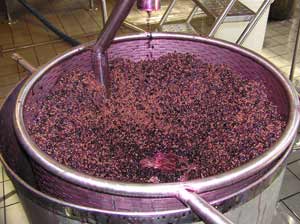
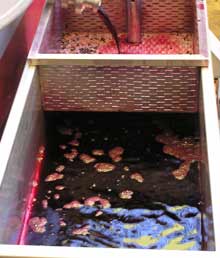
First pressing of the 2006 season. Yesterday we pressed out Block AB Merlot…our first harvest. The drain wine is black red; deeply colored, and such a pleasure to see and taste. Today it will be barreled, into all new barrels from 3 different coopers. This is a full flavored block with a fine history and benefits from new oak, which provides a rich foundation for

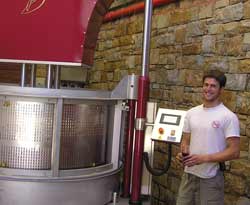
the wine, without overwhelming it aromatically with oak. We like subtle, well aged, French oak. See photos of our first pressing: (1) Dark Merlot as it drains from the press; (2) seeds from the bottom of the fermenter - they do not go into the press; (3) Bernard, doing his first press for Vilafonte.

Zelma Long, Vilafonte winemaker

Friday, February 24, 2006

Vilafonte Harvest Wednesday Feb 22

Our Malbec says "feed me"
Bernard came into the cellar this morning and boy was it "stinky"! And it was due to our tank of Malbec..which had fermented down from 20 Brix to 15 Brix overnight…this is very fast…and in moving so quickly had used up its nutrients.When this happens the yeast start to stress and put off less-than-ideal aromas…in this case hydrogen sulfide (smells like rotten eggs). So he knew the minute he came in that the yeast needed feeding! We do monitor the natural nitrogen that comes in with the crushed grapes, but we don't know the natural level of vitamins and minerals. When the yeast start to stress (which may or may not happen during a fermentation) we give them a mix of yeast hulls, which have vitamins and minerals, and nitrogen. We want them to be happy so they will finish the fermentation, but not so happy that the sugars (Brix) will drop like a rock. We want time for the skins and fermenting juice, to mingle, so that all the "goodies" in the skins (color, tannins for texture, aromas and flavor) have time to be extracted out into the wine.
We love our Malbec wine; this is our only fermenter; as wine it gives flesh to our Series M blend. After feeding today, it reverted to its normal, ripe black fruit aromas, once again a happy fermenter.
Zelma Long

Wednesday, February 22, 2006

Vilafonte Harvest Tues Feb 21 - day 17

Harvest Decisions and Harvest Pace
I am out in the vineyard early to see how the Cabernet Franc, and block E Merlot, are doing. We checked them Saturday; they seemed "nearly ripe"; and I want to see if we want to bring them in this week, and how they look after the rain. Julie is sampling each of them, to check phenolics (color and tannin) and Brix, acid and pH. I will pool our observations (of seed color, ripe flavors, skin texture, etc) with the chemistry and decide about harvest later this week. For the time being, I have put off our Wednesday harvest to Thursday; due to Monday rain. But all Cab Franc seeds are brown; I think this block is ready to come off; and by the appearances of the Merlot it should be ready by Friday.
Today is clear and sunny; last night was chilly; this morning we had a steady breeze which was GREAT!!! ...dried off the leaves and clusters. This is just lovely ripening weather for the Cabernets that are coming up. As you can tell if you've been following us; pace of harvest has been slow and steady. Measured, if you will … time to consider each detail with each vineyard as it comes to the winery. Ideal. Almost too good to be true…but it is early days yet.
Zelma Long

Vilafonté Harvest Blog Feb 20th - Day 16


A Rainy Day...
We woke up to grey skies and drizzle, and the drizzle/intermittent heavy rain continued through to mid afternoon when the skies went from grey to blue and white. Is this a bad thing…this rain in the midst of harvest???
For us, no. All of Vilafonté is red grapes, and with open clusters and thicker, more rainproof skins. In fact Phil was delighted; the dust will be washed off the leaves and the whole vineyard refreshed. If the rain were prolonged and heavy; if we had white grapes that have thinner skins; if we had Pinot Noir which has tight clusters; the story might be different. But for us, we welcome this cleansing.And previously, I have seen this type of rain seem to "kick" the grapes into ripeness; maybe it is the water; maybe just a warning to them to get on and ripen their seeds (we are interested in the fruit, but the grapevine is all about ripening and distributing its seeds.
Zelma Long

Tuesday, February 21, 2006

Vilafonte Harvest Blog Thursday - day 12

CLICK HERE TO LISTEN TO A HARVEST INTERVIEW PODCAST WITH ZELMA LONG
Of Termites and Terroirs
A quiet day, for a change; crushed grapes are resting and releasing their color; AB fermentation is revving up, and we are not harvesting. There is a certain peacefulness here.But in the vineyard, Phil is make plans for a new planting to be done next spring.We are putting in 7 more acres of vines, and he is doing a thorough soil study. A smart guy, he wants to be sure that spacing, row direction, drainage, soil amendments and soil treatment are all correct to give the new vines a chance to grow evenly. So I ran into a soil scientist, out flagging locations for backhoe pits so soil samples can be taken and Phil can see how the soil changes, for his planning.We have some spots that appear very distinctive on the analysis and also some places in our existing vineyard where vines don't grow well. The scientist told me that these might be from old termite mounds, although he was careful to say that only analysis would show that. He said that the "termite mound soils" are very different; more alkaline, more lime, more salts. They tend to be small areas, and round. Later that evening, Ronald told me that other "historical" impacts on the soils were (1) areas where settlers had cleared and mounded up trees and brush for large burns, affecting the soils underneath; and (2) areas that had been used for"kraals" - corrals where the tribes kept cattle as they moved from place to place.As it turned out, our spots are more prosaic…merely areas where the clay comes clear to the surface; and they will need organic material incorporated (straw, compost, cover crop, etc) to improve the soil for the vines.
Zelma Long

Friday, February 17, 2006

Vilafonte Harvest Blog, MALBEC - day 11


Today is a Malbec harvest day.
We don't grow much of this, and it is a very distinctive variety; bigger berries, lots of color and very soft tannins,a nice blender and, as I have tasted from 80 year old vines while I was in Argentina, can make a very rich wine. Malbec is also juicy, and so it is the one variety that we do not berry sort - too much juice running everywhere. Instead, we will sort the clusters as they go into the destemmer.
Other news: Block AB, harvested last week, has, after several days of "coldsoak"; been yeasted and is starting fermentation. This will be our first fermentation; an exciting new stage in harvest. The cellar is starting to smell wonderful; of yeast and fermenting wine.
Weather: it was chilly last night; warm but not hot today. Perfect ripening weather. We had a very hot day last Saturday and Saturday night; Phil said the vines were "sighing" a bit about it, and he gave them all a drink. They have perked up with this cooler trend and are continuing to ripen the fruit nicely.
Zelma Long

Valentine's day, Vilafonte 2006, Tuesday

Sorting in photos:
I talked about sorting on Friday but photos are the best way to demonstrate, short of being on the sorting line (hard work, long days). So here are some photos showing the process and results.
#1 As grapes go into destemmer, the first sort post vineyard
#2 This is what is taken out from this first sort
#3 This is what is removed immediately after the destemmer. Notice the number of pieces of stems that come through. No matter how good a stemmer wehave, nor how well or cannily it is run, I have never seen a destemmer that doesn't send some of those undesirable green stem pieces through.
#4 We have 6-7 people doing this final sort, removing raisins, and lighter grapesprimarily although still removing some green matter
#5 This is what they take out
#6 Nice, clean, purple grapes falling into the fermenter. The amount removed is not large in either weight or volume, but it is important to remove. And consider, most of the leaves that are accidentally picked are removed from the bins while still in the vineyard. So the grapes come in pretty clean, and we are "perfecting" them, at the rate of about 1 ton/hour. These are photos of Block Z Merlot, that should produce a rich, dense Merlot.
Zelma Long

Wednesday, February 15, 2006

Vilafonté Harvest Blog 2006, Monday Feb 13 Day 9

Today we are bringing in one of our loveliest blocks, Block Z Merlot. It is a sensitive block; if you get it right, in the vineyard and winery, it is wonderful; dark, rich palate, black fruit aromas. But equally if we get it wrong it can be tart and lean. It is a building block for the 'Series C' and I sweat bullets over this block every year.
What is the magic "ripeness", anyway?? A computer model for it would be quite complex, and it would take into account:
Vine: color of leaves, shoots and stems. Can it continue to ripen its load?
Clusters: deep purple color. Good condition. Equally ripe across the block.
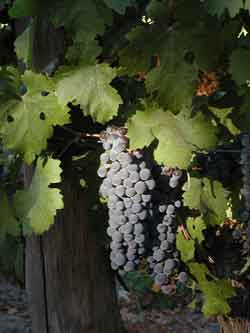
Berries: purple black color, brown seeds not green, thin skins, flesh pulls away from seed; a 'melt in your mouth" texture, soft tannins, not astringent; nice flavors and balance of sugar-acid.
Chemistry: good balance of potential alcohol, acid and pH.
And then there is experience and intuition, plus…what do you want to make with these grapes anyway? Style? Flavor profile?

But personally, after all the visual, flavor, texture and data input; it ends up…what does my gut tell me? On Saturday, Block Z Merlot said to me: "pick me Monday"!
Zelma Long
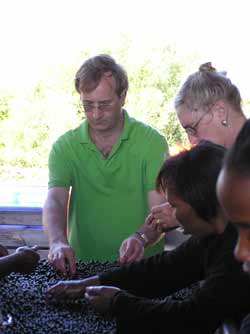
PS These photos show the sorting table process of removing of poor quality grapes, stalks, raisins and any MOG (material other than grapes).

Tuesday, February 14, 2006

Vilafonte 'Weekend Blog' 2006, Saturday Feb 11

CLICK HERE TO LISTEN TO PHIL FREESE DISCUSS THIS YEARS WINE-GROWING ON OUR DAILY PODCAST
We hit the vineyard around 8:30 am, so that Julie could sample 3 blocks first, and get them in for phenolic analysis at 8 am, and join us. Last night was warm; the grape bunches are warm, and the air is warm!! We checked Z Merlot to be sure we want to harvest it Monday (yes); looked at the Malbec and AC and E Merlot to figure when they are likely to be ready, then looked at B,C,D Cabernet and F Cabernet Franc. Then, as is our way, we adjourned for a cappuccino and breakfast at Cottage Fromage at Vrede en Lust winery to discuss all the information at hand.
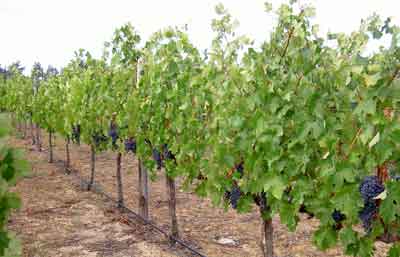
Here is what is going on in the vineyard:
a. a major improvement in ripeness since Thursday when I last checked E and V (likely next up for harvest).
b. We decided to harvest upper and lower Z Merlot together; they have come very close in ripeness
c. B,C, and D, Cabernet, are closing in on harvest; it looks like they are likely to be right on the heels of the last of the Merlot, instead of a week or 2 later as is often the case.
d. Vines look good; leaves are green; berries are firm; slightly softer than last week but still in very healthy condition…what we need for continued ripening.

Phil did an information download and here is what else we saw from the data:
a. The rate of increase in Brix mentioned in earlier blogs has screeched to a halt; flattening out. This is GREAT NEWS since the stems & grapes are not yet physiologically ripe; so if we can get some ripening time without an increase in Brix, we will be sitting pretty!
b. Around Feb 2 - 4, we saw a spike in Brix in all sites, then the brix came back down. Normally we would think the spike was due to a bit of berry shrivel but berry size (which we measure every time we sample) did not change. At some level it is nice to know that we don't understand everything; that there are still mysteries to be explained, and, at least for the time being, this is one.
c. Berry variabilities look good; several are better than in earlier samples; Some have widened in distribution. We are sampling blocks over a time line to develop our understanding of the change in evenness of a vineyard as it approaches harvest
Photo is the Saturday morning "ripeness team"; we all go together weekly to look at the vineyard: Julie, Phil, Zelma, Bernard (left to right). Ronald joined us last week but is too busy with his other harvests today.
Zelma Long

Monday, February 13, 2006

Vilafonte Sorting Blog 2006, Friday February 10th Day 6

CLICK HERE FOR TODAYS PODCAST INTERVIEW WITH BARTHOLOMEW BROADBENT AND TALES OF HIS FIRST GRAPE SORTING EXPERIENCE
A word on grape sorting before crushing…I love it. I first did it here in South Africa, 5 years ago. It changes the traditional idea of destem-crush. Here it is destem-sort-crush; or sort-destem-sort-crush (for more variable grapes); or, depending on your winemaking plan…destem-sort-no crush!We do pick our grapes clean in the vineyard, and they look good when coming in the bins. But once the grapes are shaken off the stems, it reveals: some little raisins hiding at the bottom of the cluster; a few green berries; some leaves that sneaked through the destemmer; a few particles of stems that broke off; some grapes that did not come off the stem cleanly. If you looked at, or weighed, what we sort out, it would not seem like much. But all of it is what we do NOT want in our fermenter. To me, we are "improving the grapes" , and I know the wine will have greater purity of fruit expression, for having done this.I also love something less tangible about the sort; those grapes rolling off the belt into their fermenter are like paint to the artist. I can see & feel their size, their color, their strengths and weaknesses; they become much more personal; I have a much better feel for this vineyard, by spending time sorting them. (Just to be clear it takes 8 sorters minimum plus someone overseeing the feeding of the grapes and removal of stems, not just me).The photo is Bartholomew Broadbent, our U.S. importer visiting South Africa for the first time; our most excellent sorters; and me; at the sorting belt. Zelma Long, Vilafonte winemaker